
Sep
HPC Standards, Brands, News
HPC Standards: residue reference materials and isotope-labelled standards from Germany
HPC Standards GmbH manufactures reference materials for residue analysis in Saxony, Germany, and is accredited by DAkkS to ISO 17034. This article sets out what the accreditation annex actually covers, how to read the manufacturer’s vial label, which analyte groups the catalogue spans, and how the range maps onto Vietnam’s list of 40 banned veterinary substances.
- Manufacturer
- HPC Standards GmbH
- Origin
- Jesewitz, Saxony, Germany
- Accreditation
- DAkkS D-RM-20844-01-01
- Standard
- DIN EN ISO 17034:2017
- Solution range
- 0.1 – 10,000 µg/mL
- HPC codes at QEMIX
- 2,367
What HPC Standards GmbH does
HPC Standards GmbH develops, manufactures and distributes reference materials for residue analysis. The catalogue covers four areas: pesticides, veterinary drugs, the metabolites of both, and stable isotope-labelled reference materials. The company is based in Jesewitz, Saxony, Germany; its trading address is Am Wieseneck 7, 04451 Cunnersdorf.
What separates HPC from most reference material suppliers on the Vietnamese market is that it manufactures rather than repackages. The direct consequence: when an analyte or a format is not in the catalogue, the company takes it on as a custom synthesis — the chemical name, the CAS Registry Number and the required specification are enough to start.
HPC is an independent company, not part of a group — unlike Dr. Ehrenstorfer, TRC and Mikromol, which all sit under LGC and which QEMIX covered in LGC reference standard brands. For a laboratory, the thing worth checking is not the size of the parent group but the scope written into the accreditation annex — the subject of the next section.
HPC states it plainly on its website: the product page and the lot-specific certificate are the controlling sources for chemical identity, assigned value, uncertainty where applicable, storage conditions and period of validity. In other words, the catalogue is for looking things up; the numbers that go into laboratory records must come from the certificate of the exact lot printed on the vial.
ISO 17034 and ISO 9001: what the scope actually covers
This section matters for ISO/IEC 17025 files, because these are the details an assessor will ask about.
HPC Standards GmbH is accredited by DAkkS — the German national accreditation body — as a reference material producer under DIN EN ISO 17034:2017, registration number D-RM-20844-01-01. The current annex was issued on 17 November 2025.
| Item | Scope as stated in the annex |
|---|---|
| Product types | Production of reference materials (RM) and certified reference materials (CRM) |
| Solid form | Pure organic substances and salts, purity above 50% |
| Solution form | Single-component solutions, 0.1 µg/mL – 10,000 µg/mL |
ISO 17034 accreditation applies only within the scope stated in the current annex, and the item-specific certificate is what determines whether a given code is a certified reference material. A manufacturer holding ISO 17034 accreditation does not mean every code in its catalogue is a CRM. When a method requires a CRM, check the certificate of that specific code rather than inferring it from the manufacturer’s accreditation mark.
Alongside this, the company’s quality management system holds ISO 9001:2015 certification issued by TÜV SÜD Management Service GmbH under registration number 12 100 46238 TMS, valid from 8 January 2026 to 2 September 2028. The certified scope covers the design, development, production and distribution of reference materials, specialty chemicals and laboratory equipment.
The two documents answer different questions: ISO 17034 speaks to the competence to assign a reference material’s value; ISO 9001 speaks to how the business is run. An ISO/IEC 17025 file needs the first one.
Three product formats and how to read the vial label
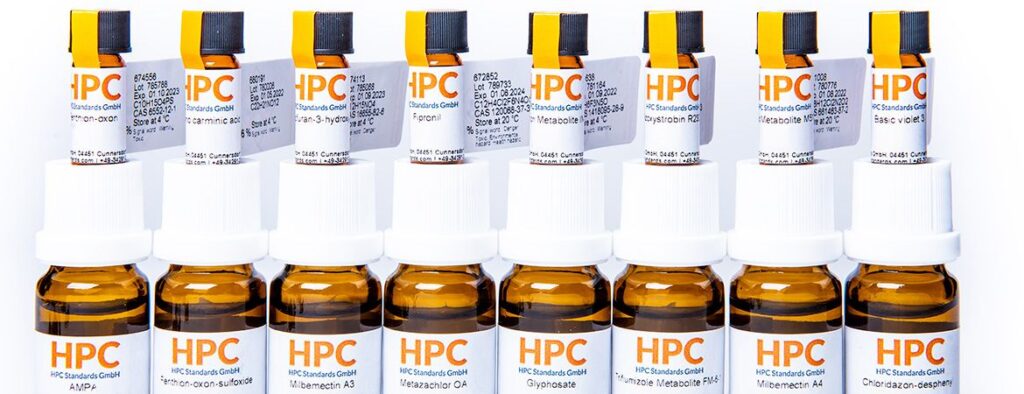
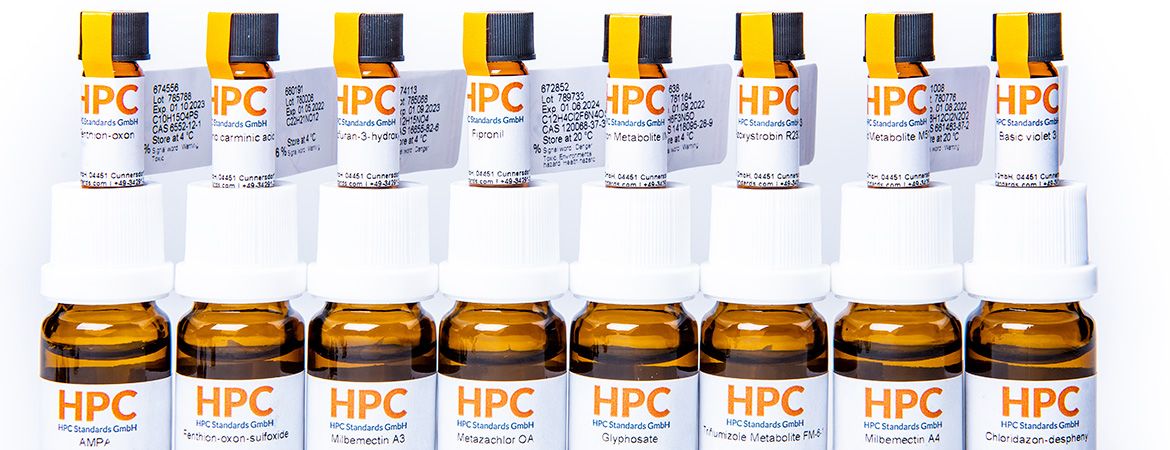
Photographs of actual HPC products held in the QEMIX catalogue.
Depending on the analyte, the HPC catalogue offers three formats: neat materials for in-house preparation, single-component solutions supplied at a defined concentration and solvent, and stable isotope-labelled internal standards. Which one to choose depends on the analytical balance available, the method’s solvent and the monthly sample throughput — no format is better in the abstract.
The side label carries the seven pieces of information a laboratory needs at goods-in and in its records:
| Label field | What it is used for |
|---|---|
| Item number | Product identity for reordering and for retrieving the certificate |
| Lot. | Lot number — the key to the correct certificate; assigned values change by lot |
| Exp. | Expiry date of the lot, used to plan reordering |
| Molecular formula | Quick check of the correct chemical form (base, salt, hydrate) |
| CAS | Cross-check against the target analyte in the method |
| Purity (%) | The factor that goes into calculating stock solution concentration |
| Store at | Storage conditions; the wrong conditions means an error from goods-in onward |
The QR code on the label leads to the manufacturer’s product record. Printing the hazard signal word and classification directly on the label allows storage to be sorted by hazard group without opening the SDS.
Four more HPC codes in the QEMIX catalogue
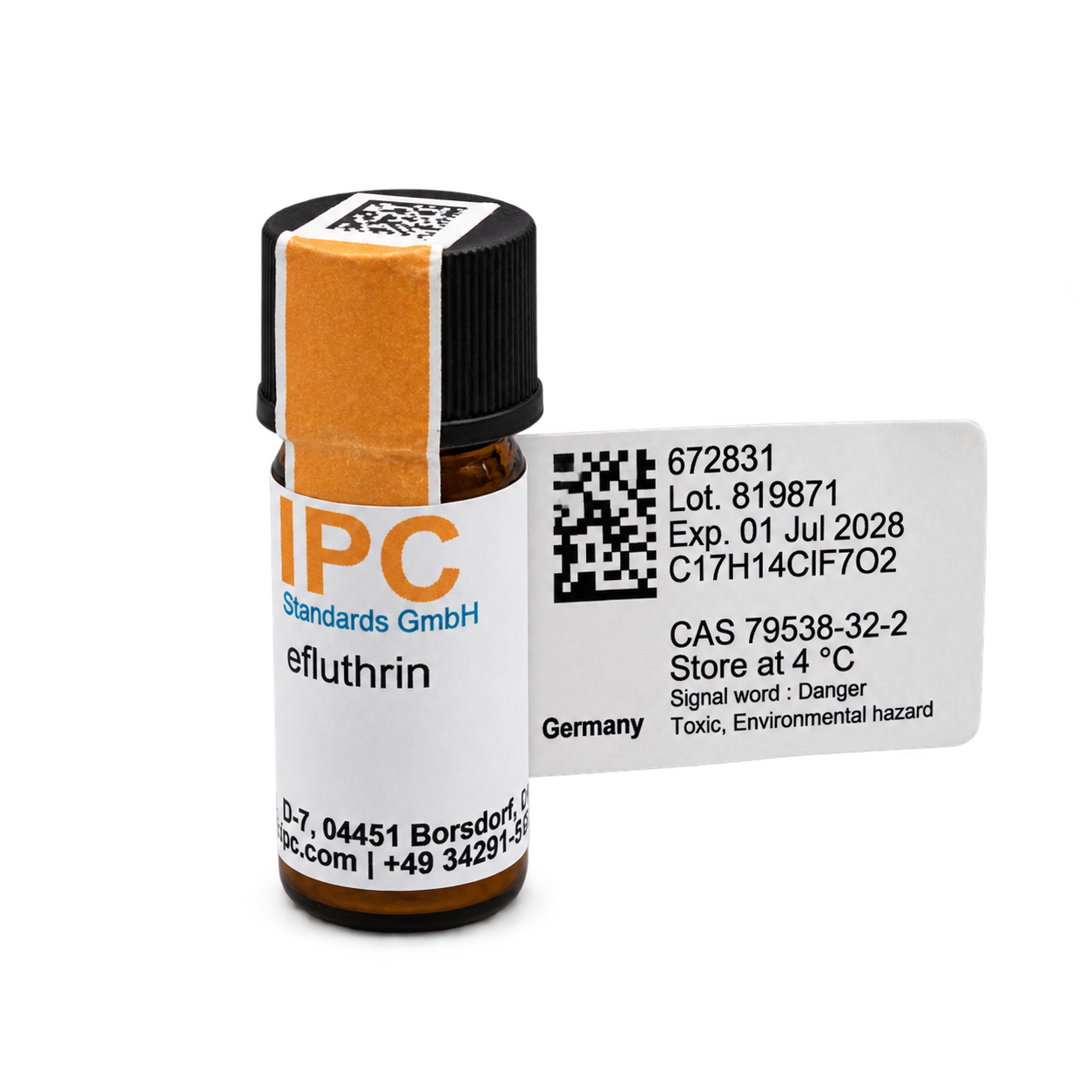
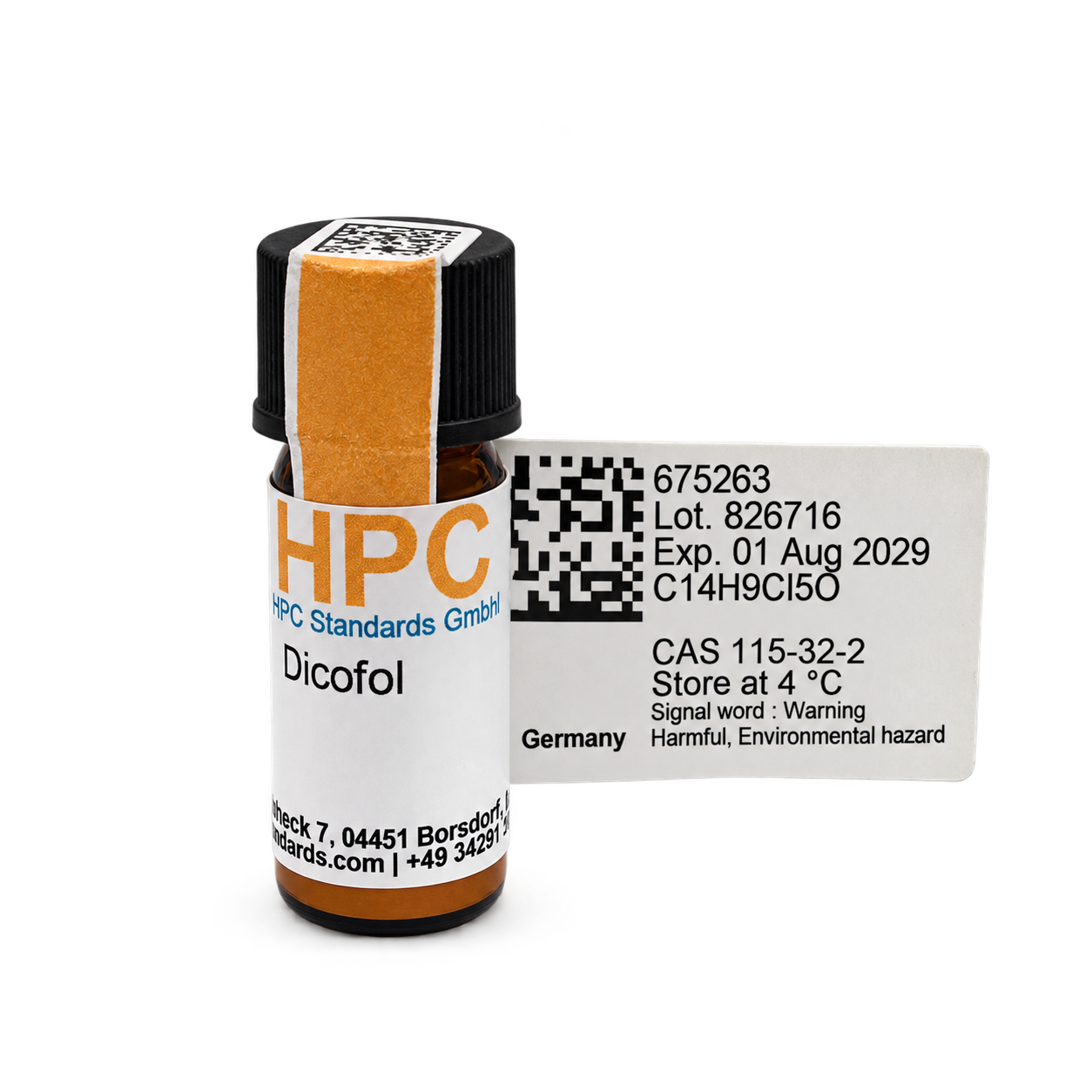
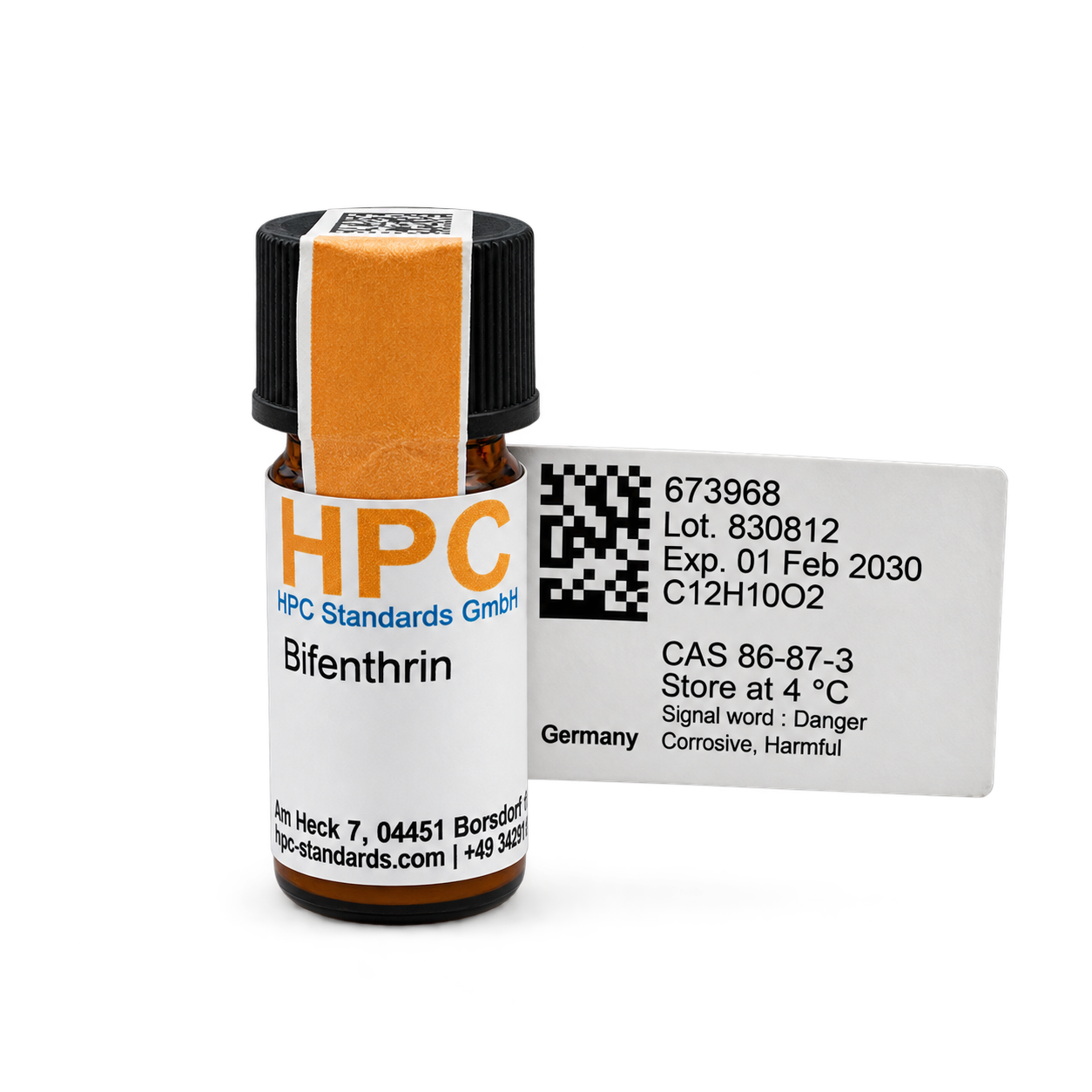
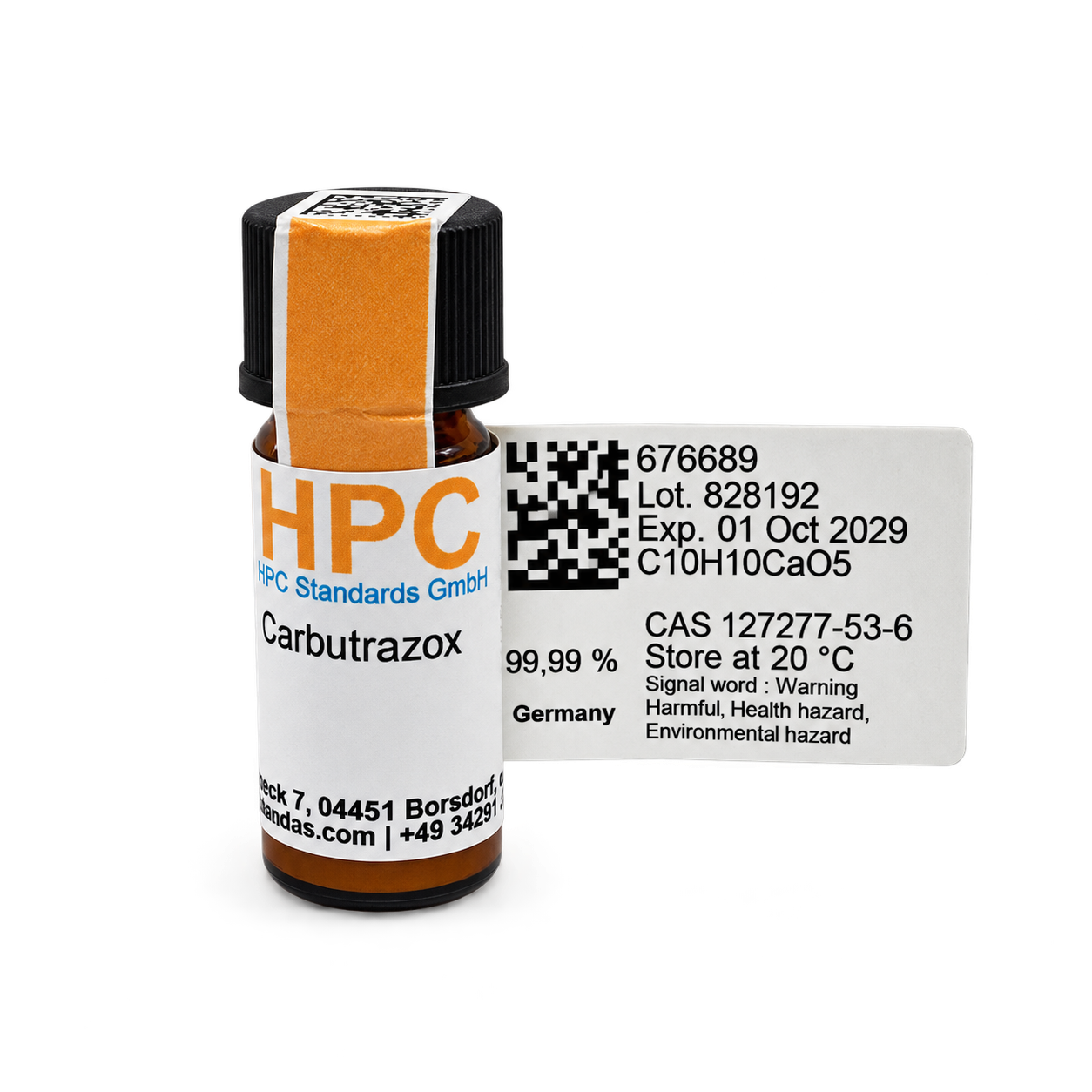
These four span three uses: a pyrethroid insecticide (Tefluthrin), an organochlorine acaricide added to Annex A of the Stockholm Convention in 2019 (Dicofol), and two plant growth regulators (1-Naphthylacetic acid, Prohexadione calcium).
The HPC range by analyte group
2,367 HPC codes are listed on qemix.co; below are real examples from each group.
HPC organises its catalogue by analyte rather than by method. For a buyer, the more useful way in is the group of parameters that has to be reported. The table below is arranged that way.
| Analyte group | Example code at QEMIX | Substance |
|---|---|---|
| Pesticides | 672861 | Imidacloprid |
| Pesticides | 673834 | Tricyclazole |
| Pesticides | 672841 | Difenoconazole |
| Pesticides | 672857 | Glyphosate |
| Mycotoxins | 687124 | Aflatoxin M1, 1 µg/mL in acetonitrile |
| Mycotoxins | 682028 | Deoxynivalenol, 100 µg/mL in acetonitrile |
| Mycotoxins | 675983 | Ochratoxin A |
| Mycotoxins | 682051 | Fumonisin B1, 50 µg/mL in acetonitrile/water |
| Veterinary drugs | 674893 | Enrofloxacin |
| Veterinary drugs | 672856 | Furazolidone |
| Process contaminants | 675336 | Acrylamide |
| Process contaminants | 673158 | rac 1,2-Bis-palmitoyl-3-chloropropanediol (3-MCPD ester) |
| Packaging and contact materials | 682740 | n-Hexadecane (MOSH/MOAH calibration) |
| Packaging and contact materials | 684121 | n-Pentyl-iso-pentylphthalate |
| Emerging parameters | 687855 | 6PPD-quinone |
| Emerging parameters | 674646 | Melamine |
Beyond these groups the catalogue also holds pesticide metabolites (ESA, OA, desmethyl, sulfoxide, sulfone and others), nitrosamines, PAHs, PCBs, bisphenols, organotin compounds, banned dyes and pharmaceutical residues in water. The full range is searchable on the HPC brand page at QEMIX.
Stable isotope-labelled standards — the part laboratories most often under-order
Without a labelled internal standard there is no isotope dilution, and no correction for matrix effects.
In LC-MS/MS on complex matrices — seafood, meat, produce, edible oil — matrix effects can shift the signal by tens of percent without a solvent calibration curve showing anything. The standard response is to add a stable isotope-labelled analogue of the target analyte at the start of sample preparation and quantify on the area ratio. The labelled compound experiences the same losses and the same ion suppression as the analyte, so the correction happens inside the calculation.
HPC manufactures both native and labelled forms for many analytes, so the analyte–internal standard pair can be sourced from one manufacturer:
| Code | Labelled internal standard | Used for |
|---|---|---|
676734 | D10-Chlorpyrifos | Chlorpyrifos residues |
676272 | D4-Carbendazim | Carbendazim residues |
676708 | D5-threo-Chloramphenicol | Chloramphenicol in aquaculture products |
677256 | D4-AOZ | Nitrofuran metabolite (furazolidone) |
679150 | 13C,15N2-Semicarbazide hydrochloride | SEM — nitrofurazone metabolite |
679207 | D9-Clenbuterol hydrochloride | Beta-agonists in meat |
679703 | 13C3-Melamine | Melamine in milk and feed |
675015 | D5-rac 1,2-Bis-palmitoyl-3-chloropropanediol | 3-MCPD esters in fats and oils |
685286 | D12-Benzo[a]pyrene | PAHs in smoked foods and edible oils |
678023 | D5-Enrofloxacin hydrochloride | Fluoroquinolones in aquaculture products |
One ordering note: several internal standards are available both as neat material and as a ready-made solution — D10-Chlorpyrifos, for instance, also exists as 678119 at 100 µg/mL in acetonitrile. Where no microbalance is available, the solution is the better choice.
Mapping onto Vietnam’s list of 40 banned veterinary substances
Circular 10/2016/TT-BNNPTNT, Annex II — 24 substances banned in aquaculture and 16 in terrestrial livestock production.
This is the list that testing laboratories serving seafood and meat exports run most often. We checked 16 representative substances from it against the HPC range currently listed on qemix.co — all 16 have a code:
| Substance in Annex II | HPC code at QEMIX |
|---|---|
| Chloramphenicol (D5-labelled form) | 676708 |
| Furazolidone | 672856 |
| Malachite green (oxalate salt) | 674879 |
| Leucomalachite green | 674880 |
| Dimetridazole (2-hydroxy metabolite) | 682388 |
| Metronidazole (hydroxy metabolite) | 682390 |
| Clenbuterol | 681416 |
| Salbutamol | 673105 |
| Ractopamine | 674907 |
| Diethylstilbestrol (DES) | 675979 |
| Ciprofloxacin | 688743 |
| Enrofloxacin | 674893 |
| Carbadox | 674871 |
| Trifluralin | 672939 |
| Deltamethrin | 688755 |
| Trichlorfon (Dipterex) | 673461 |
The table above maps 16 representative substances, not the full 40 entries of Annex II. We are not claiming HPC covers the list in full. For the remaining parameters, the reliable approach is to send the laboratory’s actual target list so QEMIX can check each one against the HPC range and report back which have codes and which would need custom synthesis.
On the pesticide side, the corresponding instrument is Circular 50/2016/TT-BYT of 30 December 2016, issued by the Ministry of Health, setting maximum residue limits for pesticides in food. For export goods, the limits of the destination market — the EU, Japan, the United States, South Korea — are usually tighter and change faster than domestic regulation, so a laboratory’s target list should follow customer requirements rather than the circular alone.
What to prepare when ordering HPC reference materials
Five pieces of information that reduce the back-and-forth to a single round.
- The CAS number, not just the name. Many analytes exist in several forms — base, salt, hydrate, isomer — and each is a separate code with a different molecular weight. The CAS number removes most of that ambiguity.
- The format required: neat or solution. If a solution, state the solvent and concentration, because changing solvent means re-evaluating the method.
- Whether a labelled internal standard is needed. If the method quantifies by isotope dilution, order the analyte and its internal standard together — an incomplete order means waiting for another import cycle.
- Any CRM requirement. If the file requires a certified reference material, say so at the outset so the certificate of each code can be checked before ordering.
- Pack size and rate of use. Reference materials carry a lot-based expiry date; buying more than a year’s requirement is rarely economical.
2,367 HPC codes are currently listed on qemix.co. These are ordered from Germany per order rather than held in stock in Vietnam; lead time depends on the production lot and on whether the code requires cold-chain shipping. Analytes not in the catalogue can be ordered as a custom synthesis through the manufacturer.
Sources, accessed September 2026: HPC Standards GmbH (catalogue description, three product formats, DAkkS accreditation D-RM-20844-01-01 to DIN EN ISO 17034:2017 with annex dated 17 November 2025, scope of purity above 50% and single-component solutions 0.1–10,000 µg/mL, ISO 9001:2015 certificate 12 100 46238 TMS from TÜV SÜD valid 8 January 2026 – 2 September 2028) · HPC Standards — Product Groups (analyte directory) · HPC Standards — Contact (Am Wieseneck 7, 04451 Cunnersdorf) · Circular 10/2016/TT-BNNPTNT (Annex II: 24 substances banned in aquaculture, 16 in terrestrial livestock) · Circular 50/2016/TT-BYT. Product codes taken from the qemix.co catalogue on 22 September 2026. Contact QEMIX: sales@qemix.co · +84 398 663 339.
Send your target analyte list with CAS numbers, the sample matrix and the solvents used in your method. QEMIX will look up each substance in the HPC catalogue, confirm the product format and the RM/CRM status per the CoA, and send a quick quote.
See HPC standards at QEMIX