
Sep
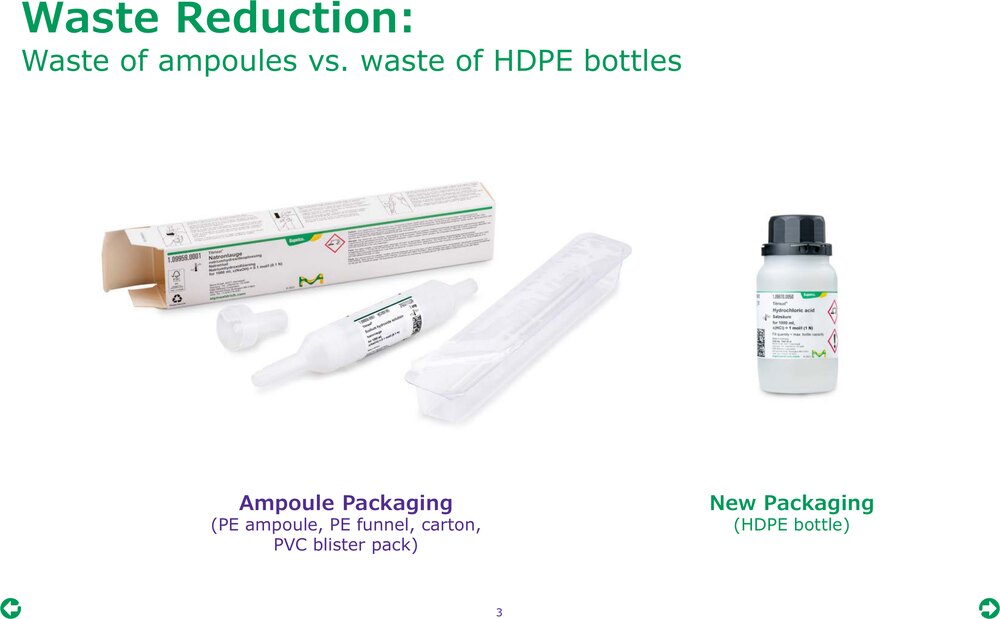
Merck has moved Titrisol® Concentrates from ampoules to small HDPE bottles, cutting packaging material and simplifying how the solution is prepared.
- Manufacturer
- Merck · Supelco
- Former packaging
- PE ampoule
- New packaging
- HDPE bottle
- Bottle sizes
- 100 mL · 250 mL
- Product groups
- Volumetric · Buffer · AAS
What are Titrisol® Concentrates?
Titrisol® is a range of pre-measured concentrates, each one diluted to make a defined volume of standard solution.
According to Merck, the range is used to prepare three kinds of solution: volumetric solutions for titration, AAS calibration standards for atomic absorption spectroscopy, and buffer calibration solutions for pH instruments.
What they share is that the laboratory does not weigh solid reagent or calculate the amount to dissolve: each Titrisol® unit is already measured for one specific final volume.
What exactly did Merck change?
Each Titrisol® unit previously came with four packaging components: a PE ampoule, a single-use PE funnel, a carton and a PVC blister pack. The new packaging is a single component, the HDPE bottle.
Merck states the PVC blister was removed because PVC is a plastic of concern.
How much packaging material does this remove?
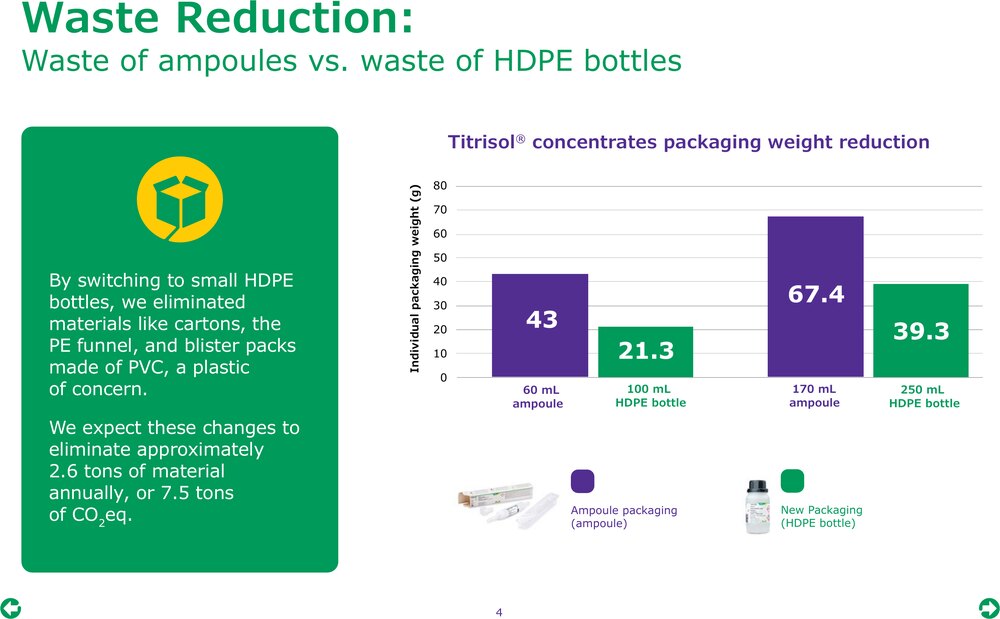
Merck published the packaging weight per unit, measured before and after the change:
The 2.6 tons and 7.5 tons CO₂eq are an estimate Merck gives for its global volume, not a measurement taken in any one laboratory. The two packaging weights per unit are measured directly and can be verified.
What changes in daily lab work?
The Merck brochure lists three points:
- Handling. Open the bottle cap and pour the solution into a volumetric flask using a funnel, instead of breaking an ampoule.
- Control over concentration. Prepare the concentration that a particular analytical method calls for.
- Cost. Less packaging can lower waste disposal and transport costs.
The third point is a possibility rather than a commitment: how much is saved depends on how each site accounts for waste disposal.
The three Titrisol® groups
Volumetric Solution Concentrates
Used for titration, to determine the exact amount of a specific compound in a sample.
Buffer Calibration Solution Concentrates
Used to calibrate pH instruments exactly to determined pH values.
Calibration Standard Concentrates
Used for the calibration of atomic absorption spectroscopy instruments.
Preparing a solution from a Titrisol® HDPE bottle
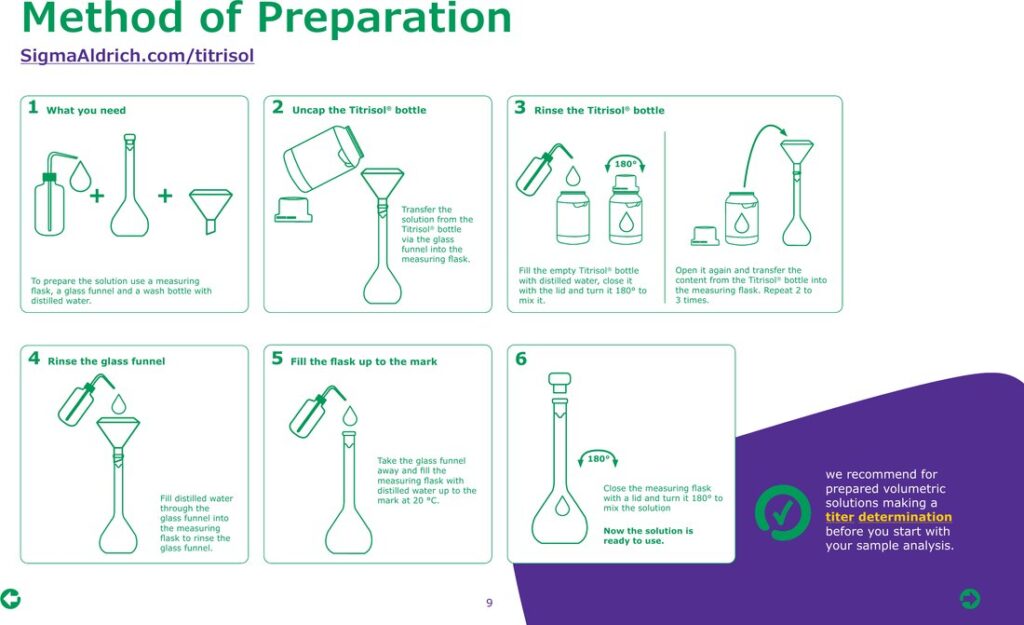
Merck describes six steps:
- What you need. A volumetric flask, a glass funnel and a wash bottle with distilled water.
- Transfer the concentrate. Uncap the Titrisol® bottle and pour the solution through the glass funnel into the volumetric flask.
- Rinse the bottle. Fill the empty Titrisol® bottle with distilled water, close it, turn it 180° to mix, then pour into the flask. Repeat 2–3 times.
- Rinse the funnel. Run distilled water through the glass funnel into the volumetric flask to rinse the funnel.
- Fill to the mark. Remove the funnel and fill with distilled water up to the mark at 20 °C.
- Mix. Close the flask and turn it 180° to mix. The solution is ready to use.
For prepared volumetric solutions, carry out a titer determination before starting sample analysis.
Selected Product No. in the HDPE range
Six representative codes across the three groups. The full list holds more, and Merck notes that additional products will follow.
| Group | Product | Order No. | Bottle |
|---|---|---|---|
| Volumetric | Sodium thiosulfate concentrate, 0.1 mol/L | 1.09950.0050 | 100 mL |
| Volumetric | Sodium hydroxide concentrate, 0.1 mol/L | 1.09959.0050 | 100 mL |
| Volumetric | Hydrochloric acid concentrate, 1 mol/L | 1.09970.0050 | 250 mL |
| Volumetric | Sulfuric acid concentrate, 0.05 mol/L | 1.09984.0050 | 100 mL |
| Buffer pH | Buffer concentrate for 500 mL, pH 7.00 | 1.09887.0050 | 100 mL |
| AAS | Iron standard concentrate, 1000 mg Fe | 1.09972.0050 | 100 mL |
The volumetric concentrates make 1000 mL of solution; the buffer concentrate makes 500 mL of buffer solution.
Send the Order No., or the product name with its concentration and pack size. QEMIX checks stock, looks up the Specification and SDS, and supplies the COA for the exact Lot No. once the batch information is confirmed.
See the Merck catalogue at QEMIX