
Jul
News
Reducing agents in organic chemistry
How reduction works, common reducing agents such as NaBH4 and LiAlH4, the Birch and Clemmensen reactions, applications and safety precautions.
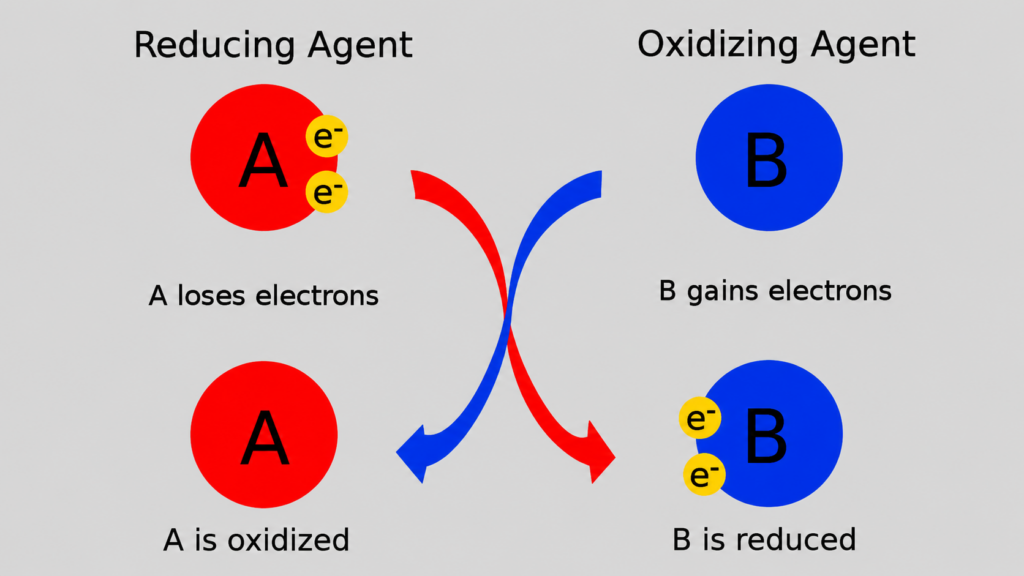
Reducing agents are chemicals able to donate electrons, or to supply hydrogen, in order to lower the oxidation state of another species. During the reaction the reducing agent is itself oxidised, while the species that accepts the electrons is reduced.
In organic synthesis, reducing agents are central to functional-group interconversion, to the synthesis of new compounds, and to process optimisation in pharmaceutical, chemical and materials research and development.
How they work
In a redox reaction:
- The reducing agent donates electrons.
- The oxidising agent accepts electrons.
- The reducing agent is oxidised.
- The oxidising agent is reduced.
For example:
CuO + H₂ → Cu + H₂O
In this reaction H₂ is the reducing agent and CuO is the oxidising agent; the copper oxide accepts electrons and is reduced to copper metal.
Common reducing agents in organic chemistry
Sodium borohydride (NaBH₄)
NaBH₄ is a mild reducing agent in wide use. It reduces aldehydes to primary alcohols and ketones to secondary alcohols, and it works under relatively safe conditions. Typical applications include pharmaceutical synthesis, the preparation of fine chemicals, and organic chemistry research.
Lithium aluminium hydride (LiAlH₄)
LiAlH₄ is a stronger reducing agent than NaBH₄. It is capable of reducing aldehydes, ketones, esters, carboxylic acids and amides. It is used in the synthesis of complex organic compounds, in medicinal chemistry research and in materials chemistry.
Hydrogen (H₂)
Hydrogen is generally used together with a metal catalyst such as palladium on carbon (Pd/C), platinum (Pt) or Raney nickel. Applications include hydrogenation of C=C double bonds, hydrogenation of C≡C triple bonds, and reduction of nitro groups to amines.
Zinc / HCl
This is a classical reducing system, used to reduce nitro groups, to reduce certain carbonyl compounds, and to carry out the Clemmensen reduction.
The Birch reduction
The Birch reduction reduces aromatic rings using sodium or lithium metal, liquid ammonia and an alcohol as the proton source. A benzene ring is converted to 1,4-cyclohexadiene. It is applied in pharmaceutical synthesis, natural-product synthesis and advanced organic chemistry research.
The Clemmensen reduction
The Clemmensen reduction uses zinc granules and concentrated hydrochloric acid to convert aldehydes and ketones to alkanes, for example R-CO-R’ → R-CH₂-R’. It is used in the synthesis of aromatic compounds, in the preparation of pharmaceutical intermediates, and in industrial chemistry.
Where reducing agents are used
Pharmaceuticals
- Synthesis of active pharmaceutical ingredients.
- Adjustment of functional groups within a drug molecule.
- Synthesis of analytical reference standards.
Analytical chemistry
- Sample preparation.
- Synthesis of reference compounds.
- Study of reaction mechanisms.
Industrial chemicals
- Polymer production.
- Fine chemicals.
- Organic intermediates.
Scientific research
- Synthesis of new molecules.
- Development of greener synthetic routes.
- Advanced materials research.
Safety notes
Many reducing agents are highly reactive. LiAlH₄ reacts violently with water, sodium metal can ignite, hydrogen is flammable and explosive, and Zn/HCl generates hydrogen gas as the reaction proceeds. Follow the SDS closely, use appropriate PPE, and work in a fume hood where required.
Conclusion
Reducing agents are indispensable to modern organic chemistry. From mild reagents such as NaBH₄ through to powerful systems such as LiAlH₄ and the Birch reduction, they make it possible to convert a wide range of important functional groups efficiently, supporting research, pharmaceutical development and the manufacture of high-quality chemicals.
Send the product name with its CAS Number, grade and pack size. QEMIX helps you look up the Specification and SDS, and supplies the COA for the exact Lot No. once the batch is confirmed.
See the brands QEMIX distributes