
Sep
Reading DUKSAN labels, Specifications, lot-specific COAs and the 16 SDS sections: Product No., CAS, lot number, UN number and GHS, plus a goods-in check.
- Origin
- South Korea
- Founded
- 1970
- Purity grades
- GR · EP · CP
- Catalogue
- Analytical reagents · Solvents
- Codes at QEMIX
- 50
The label, the COA, the SDS and the Specification are the four documents that accompany every DUKSAN chemical. Reading them correctly lets a laboratory receive the right product, store it properly and hold complete records for ISO/IEC 17025 or GMP audits — or when an unexpected result needs to be traced.
This article explains each item in the order you meet it in practice: the label at goods-in, the Specification when choosing a product, the lot-specific COA on receipt and the SDS before use. Terms follow the GHS (Globally Harmonized System of Classification and Labelling of Chemicals) and the way DUKSAN publishes its documents on duksan.kr.
What is on a DUKSAN label?
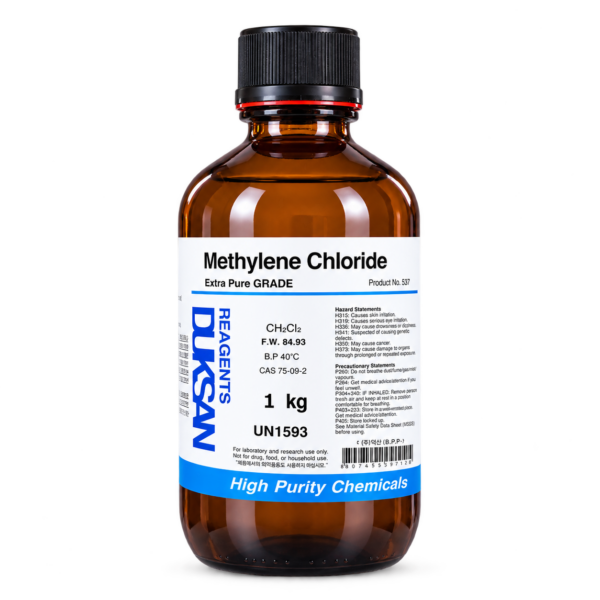
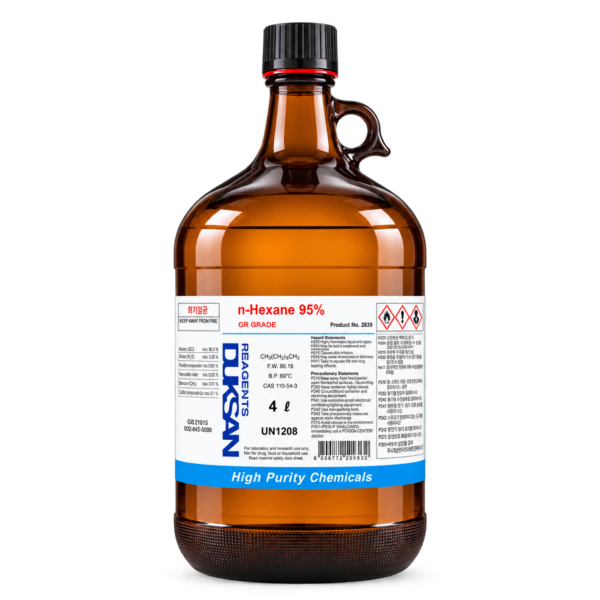
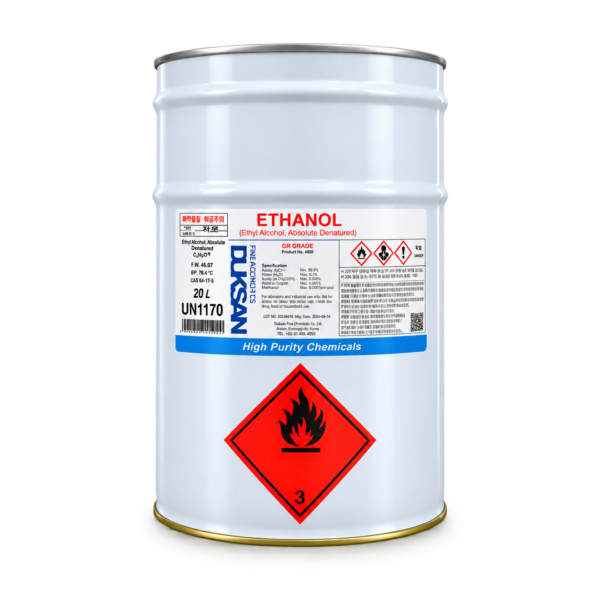
The label is the first — and the only — document that always travels with the product. Under GHS a label must carry the product identifier, supplier details, hazard pictograms, a signal word, hazard statements (H) and precautionary statements (P).
Product name, formula, F.W., CAS
The English trade name used by DUKSAN (for example Methylene Chloride, Sodium Carbonate anhydrous), the chemical formula, the formula weight (F.W.) and the CAS number. The CAS number identifies the substance, not the product: CAS 7664-93-9 covers Sulfuric Acid in several grades and pack sizes.
Grade and Product No.
The grade line (GR, Extra Pure, CP, HPLC…) gives the quality level; the Product No. is DUKSAN’s unique product code, tied to one combination of name + grade + pack size. This is the code to put on purchase orders and test records — do not use the CAS number in its place.
Lot number, production date, pack size
The lot number (Lot No.) is the key to the COA and to traceability. The pack size (500 g, 1 kg, 1 L, 2.5 L, 4 L, 20 L…) on the label must match the order and the delivery note. Where a product has a shelf life, the expiry or production date appears on the label or the COA.
GHS: pictograms, signal word, H and P statements
Hazard pictograms (flame, corrosion, exclamation mark, health hazard…), the signal word Danger or Warning, H codes (hazard statements, e.g. H225 highly flammable liquid and vapour) and P codes (precautionary statements, e.g. P403+P233 store in a well-ventilated place, keep container tightly closed). The label also carries the UN number for dangerous-goods transport, e.g. UN1170 for ethanol, UN1593 for dichloromethane.
Analytical reagent labels normally state “For laboratory and research use only” — analytical reagents must not be used as pharmaceutical raw materials, food ingredients or for household purposes. Pharmaceutical Raw Materials and Food Additives are separate DUKSAN product lines with a different quality file.
Specification — the basis for choosing the right grade
The Specification lists the parameters every lot of a given Product No. must meet. The COA reports the actual results of one specific lot against that Specification.
For analytical chemicals the Specification typically covers: assay and the method used, water content, residue after evaporation or ignition, acidity/alkalinity, ionic impurities (chloride, sulfate, nitrate…), heavy metals and application-specific parameters (UV absorbance for HPLC solvents, ECD-detectable residue for Pesticide-grade solvents…). DUKSAN publishes Specifications openly under PRODUCTS › Specification on duksan.kr, searchable by product name, Product No. or CAS number.
- Identify the parameters that matter for your test. HPLC-UV needs low UV absorbance at the working wavelength; titration needs an accurate assay; trace-metal analysis needs heavy-metal limits.
- Compare Specification with Specification. When considering another brand’s product, compare each parameter — not the grade names, because one brand’s “GR” is not automatically equivalent to another’s “GR” or “ACS”.
- Put the Product No. on your quotation request. This avoids confusion between products with the same name and CAS number but different grade or pack size.
COA — what to check on the lot certificate
The COA (Certificate of Analysis) is the quality record of the exact lot you receive. QEMIX supplies the COA issued by DUKSAN for the lot number printed on the packaging, never a “representative” COA from another lot.
| Item on the COA | Check against | Why it matters |
|---|---|---|
| Product name, Product No., grade | Label and purchase order | Confirms the COA is for the right product |
| Lot No. | Lot number on the label | Confirms the COA is for the right lot — the most frequently missed check |
| Parameters, limits (Specification) and results | Published Specification | All results must be within limits; record actual values for calculations (e.g. the actual assay of a titrant) |
| Test date, production date / expiry date | Stock policy (FEFO) | Basis for expiry ranking and stock-check schedule |
| Tested / approved by | — | Validity of the document during audits |
The lot number is the link between label, COA and test record. When an analytical result is out of trend, the first thing an assessor asks for is the lot number of the chemical used and the COA for that lot. Record the lot number in your notebook or LIMS as soon as the bottle is opened.
SDS — the 16 sections and which ones to read first
A GHS-format SDS (Safety Data Sheet, also called MSDS) has 16 fixed sections. DUKSAN publishes SDS under PRODUCTS › MSDS on duksan.kr, searchable by product name or CAS number.
| Section | Content | When to read it |
|---|---|---|
| 1. Identification | Product name, manufacturer, recommended use | Goods-in |
| 2. Hazard identification | GHS classification, pictograms, signal word, H/P codes | Before opening |
| 3. Composition | Components, CAS numbers, concentrations | Chemical declarations |
| 4. First-aid measures | Inhalation, skin/eye contact, ingestion | Post at the workplace |
| 5. Fire-fighting | Suitable and unsuitable extinguishing media | Fire plan |
| 6. Accidental release | Containment, collection, clean-up | Spill-kit preparation |
| 7. Handling and storage | Storage conditions, incompatible materials | Store layout |
| 8. Exposure controls / PPE | Exposure limits, ventilation, protective equipment | Before handling |
| 9. Physical and chemical properties | Boiling point, flash point, density, solubility… | Experiment design |
| 10. Stability and reactivity | Conditions to avoid, hazardous decomposition products | Storage |
| 11–12. Toxicological, ecological | Toxicity and environmental data | Risk assessment |
| 13. Disposal | Waste-handling guidance | Hazardous-waste records |
| 14. Transport | UN number, proper shipping name, packing group | Ordering, shipping |
| 15–16. Regulatory, other | Applicable regulations, issue/revision date | Version control |
Sections 2, 7, 8 and 14 determine how you receive, store and transport the product; sections 4, 5 and 6 should be printed and kept in the work area. Check the revision date in section 16 to make sure you are using the latest SDS version.
Five checks when receiving a bottle of DUKSAN chemical
- Check the label against the order. Name, grade, Product No., pack size.
- Check the lot number on the label against the COA. Wrong lot — request the correct COA before booking the goods in.
- Check the packaging. Cap seal, leaks, unusual discolouration compared with the description in SDS section 9.
- Record the lot number and receipt date. In the stock register or LIMS; add a secondary label if your procedure requires it.
- Store according to SDS section 7. Segregate acids, bases, flammable solvents and oxidisers; apply FEFO by expiry date.
Need the COA, SDS or Specification for a DUKSAN item?
Send the Product No. or product name + CAS number. QEMIX sends the latest Specification and SDS, the lot-specific COA at delivery, and supports chemical declaration files where required.
References: DUKSAN Pure Chemicals Co., Ltd. — duksan.kr, PRODUCTS (MSDS, COA, Specification) and COMPANY › Business, accessed September 2026; United Nations Globally Harmonized System of Classification and Labelling of Chemicals (GHS) — labelling requirements and the 16-section SDS format.
Send the Product No. or the product name with its CAS Number. QEMIX helps you look up the Specification and SDS, and supplies the COA for the exact Lot No. once the batch information is confirmed.
See the DUKSAN catalogue